


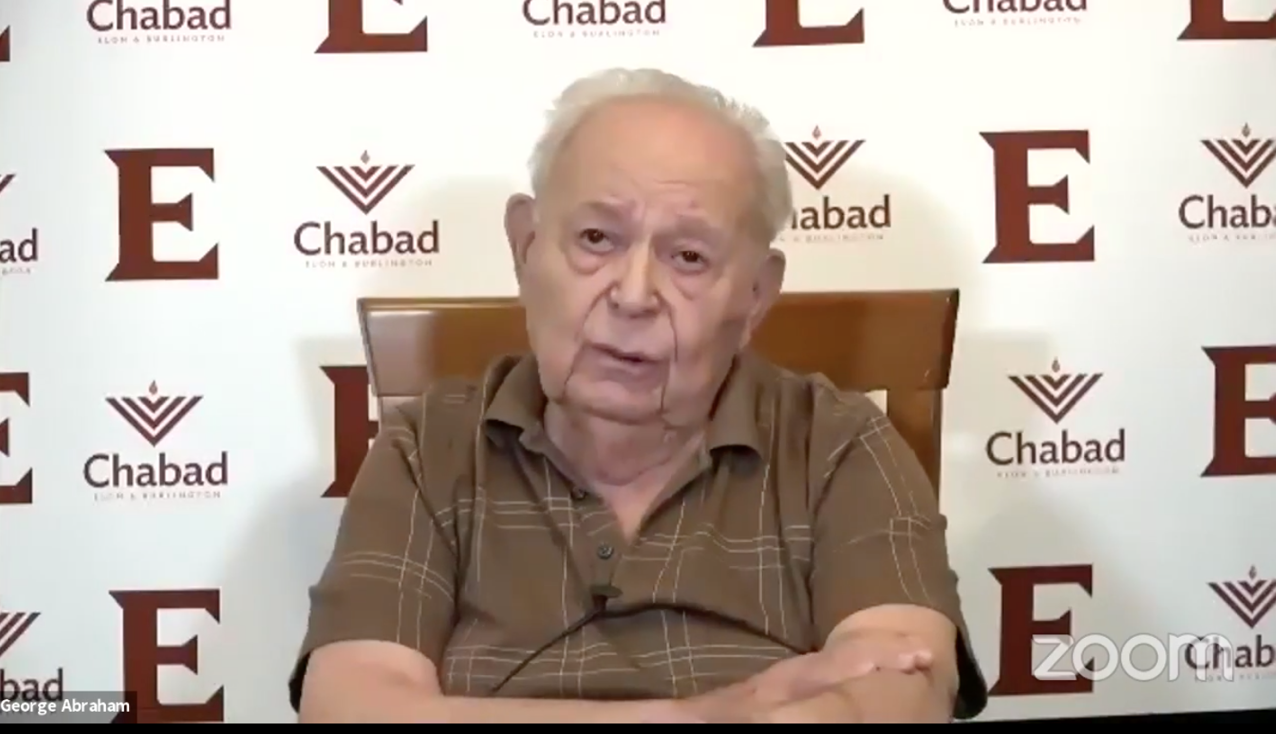
George Abraham, a Holocaust survivor and Elon grandparent, shared his story with the Elon community in a Facebook Live event on Nov. 5.
Members of the Elon community gathered virtually to hear a firsthand account of the atrocities of the Holocaust from someone who survived to share his story.
Students, faculty and staff tuned into Facebook Live for 鈥淎n Evening with George Abraham,鈥� an opportunity to hear from Holocaust survivor and Elon grandparent George Abraham as he shared his memories and stories of survival.
The virtual event, hosted on Nov. 5, was cosponsored by Chabad Elon; the Center for the Study of Religion, Culture and Society; Elon College, the College of Arts & Sciences; Elon Hillel; the Truitt Center for Religious and Spiritual Life; and the Office of Cultural and Special Programs.
Following a brief introduction by Rabbi Mendy Minkowitz and Samantha Herbert 鈥�22, Abraham shared his story, which began with his birth in Transylvania in 1931. His mother and father, who both worked in business, had two other sons. Their home was a part of Romania, which was occupied by Hungary until 1944.
Abraham attended a Jewish elementary school, but as the Hungarian occupation became more intense and dangerous, he was forced to attend a standard middle school. Abraham says it was around that time that he became more aware of discrimination against Jewish people.
鈥淚 started to notice how the occupation of Hungary started to affect us,鈥� said Abraham. 鈥淲e had to wear yellow stars when we left the house, and eventually we weren鈥檛 allowed to leave our homes at all.鈥�
As Abraham explained to the virtual audience at Elon, the German military began its occupation of Romania in March 1944 and forced his family and neighbors to leave their homes and relocate to an abandoned brick factory.
鈥淲e could only take what we could carry,鈥� he said. 鈥淚n the ghetto, some lived in the building, while others slept outside in tents.鈥�
Weeks later, the community was forced to relocate yet again as it marched to a railroad station to be piled into crowded cattle cars containing 80 to 85 people. Passengers were supplied with buckets of water, which functioned as toilets once empty.
鈥淲e couldn鈥檛 sit down,鈥� said Abraham. 鈥淭here was no privacy. Mothers, grandmothers had to use the buckets in front of everyone.鈥�
After four days, the cattle cars arrived at the Auschwitz-Birkenau concentration camp. Abraham was immediately separated from his mother and his younger brother and waited in line with his father and older brother. When he was deemed strong enough to work, Abraham was separated from the rest of his family.
鈥淢y father told me 鈥榚at,鈥� even if the food was very bad,鈥� he said. 鈥淗e told me to go straight home afterwards, and to wait for him there.鈥�
Abraham remained in the camp for seven months. During that time, he was selected for inspection by the S.S. guards three times but managed to escape back into his bunk each time.
In January 1945, when the end of the war loomed and the defeat of the Germans was inevitable, Abraham and the rest of the Auschwitz prisoners were forced to march 287 miles from the camp to German-occupied Austria, as the German military evacuated the concentration camp.

鈥淓veryone was given a loaf of bread for the trip,鈥� said Abraham. 鈥淲e wore rags and torn shoes in the freezing weather. If you stopped or were too weak to continue, you were shot on the spot by the S.S. guards.鈥�
Once the prisoners arrived in Austria, Abraham was confined to a hospital building to get treatment for his frostbitten toes. He remained in the hospital for months, receiving just a cup of broth once a day. Fortunately, his rescue was soon to come.
On May 6, 1945, the American military arrived to liberate Abraham and the rest of the prisoners. Abraham described to the Elon community the relief and simultaneous apprehension the liberated prisoners felt that day.
鈥淲e had survived the Nazis, but we didn鈥檛 know how we鈥檇 survive the rest of our lives,鈥� Abraham said.
The American soldiers provided the malnourished prisoners with clothing and food, and three weeks after liberation, Abraham began his journey home.
鈥淧eople kept telling me to immigrate to the United States, that they had rescued me and I would be safe,鈥� he recalled. 鈥淏ut I had to go home. My family was waiting for me.鈥� But, after returning home, Abraham learned that his father and brother died three weeks before the American soldiers arrived.
Abraham remained in his hometown to live with his uncle until he married his wife Cela in 1954. Shortly after the birth of his first daughter, Abraham moved his new family to Israel.
The Abrahams had another daughter in Israel before the family moved to the United States, where Abraham worked as a vice president for Carnival Cruise Lines until his retirement in 2002. He now has four grandchildren and currently resides in Cooper City, Florida. One of his granddaughters, Liat Shufilita, is a member of Elon鈥檚 Class of 2020.
During the Nov. 5 virtual discussion at Elon, Rabbi Minkowitz moderated a question-and-answer session between Abraham and the audience. Minkowitz said discussions like these are necessary.
鈥淲e all know the value and importance of listening to survivors鈥� stories, of educating the next generation,鈥� said Minkowitz. 鈥淚f nothing else, we must learn this so anti-Semitism never happens again.鈥�
Following a few questions from the Elon community, Abraham left the audience with one critical request.
鈥淚 hope that everyone will realize what a danger hatred is,鈥� he said. 鈥淚nstead of that, people will love and respect each other. Please keep this one thing in mind 鈥� no hating.鈥�