


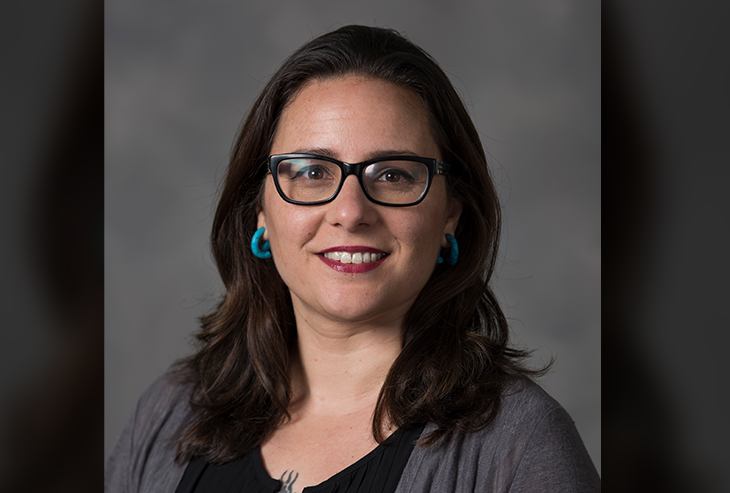
Medical anthropologist Jennifer Carroll is interested in how people's understanding or misunderstanding of epidemiology lead to decisions and value judgments we make around the virus.
As the world comes to grips with COVID-19, Assistant Professor of Anthropology Jennifer Carroll is watching and listening for stories, themes and conflicts that emerge.

How we react to public messaging and information or the lack of it, and how we create narratives around disease and pandemic will reflect our values as a society, the medical anthropologist said this week.
Carroll鈥檚 background is in opioid addiction and treatment 鈥� she was the lead author of the Centers for Disease Control鈥檚 recommendations in best practices to combat opioid overdoses in communities 鈥� but she has also studied and taught epidemiology. She admitted this week, as Elon moved to online courses and classes resumed, that she鈥檇 limited her exposure to commentary and opinion pieces by non-experts about the virus even while paying attention to public messaging and social media chatter.
Among the topics she was watching were:
- conversations around trust in the CDC and its data;
- the ways data are being collected and measured concerning the spread of the virus, and whether that data can accurately be compared from one area to another;
- how government leaders are reacting to increasing numbers of cases; and
- decisions society is making about how to proceed in a time of uncertainty.
In general, Carroll extolled the virtues of the CDC鈥檚 data collection and monitoring of state and local issues. Though she cautioned that she isn鈥檛 in a position to know firsthand about the agency鈥檚 COVID-19 response, she believes the CDC鈥檚 capability was hindered by cuts to its resources and by limited resources at state and local levels.
鈥淭he CDC are tasked with servicing health departments, not necessarily the public,鈥� Carroll said. 鈥淚 think they鈥檙e doing an incredible job with the resources they鈥檙e given, but that they lack some of the resources they need. The CDC are such good public health experts. They may stumble here and there with public messaging, but their capacities, when fully resourced, are incredible.鈥�
She pointed to successes in public messaging around COVID-19, including health and safety measures and the launching of an app that identifies virus symptoms to help users decide whether to seek medical treatment.
Fighting misinformation around the disease will require wider knowledge of basic epidemiology among officials and the general public.
鈥淚t鈥檚 about denominators,鈥� Carroll said. 鈥淔or the most part, the math of epidemiology is fractions: the proportion of people affected, the rate of change over time. What鈥檚 challenging is the conceptual problem of what it actually is that you鈥檝e just measured. That鈥檚 more complicated than most give it credit for.鈥�
We don鈥檛 yet have a common denominator yet because of irregularities in current COVID-19 testing from location to location. If one location is testing more people in the general public, including people who aren鈥檛 symptomatic or severely ill, those results can鈥檛 be compared to a location that is only testing the critically ill. That means it鈥檚 impossible to accurately gauge the rate of infection and severity of the virus.
鈥淢easuring epidemiologic curves, just like making comparisons across locations, is difficult because testing strategies are different and the counting was done differently 鈥� I think it鈥檚 going to be at best months and possibly years (to see what) the epidemic looked like as we were living through it,鈥� Carroll said.
As some politicians have grown impatient with shutdowns and accompanying economic impacts, the conversation has turned toward the different costs of the virus. Some have begun publicly weighing the loss of life versus the loss of a strong economy.
鈥淚鈥檓 not in a position to truly assess or make an informed argument about what path is better,鈥� Carroll said. 鈥淏ut we do know that if we return to normal, we are going to have a lot of sick people and overcrowded hospitals. A lot of people are going to die and there鈥檚 going to be a lot of collateral damage. At the same time, if we stay in lockdown there鈥檚 also damage: Businesses are closed, there鈥檚 a loss of jobs. What about the homeless? What about retirements and futures beyond this moment?
鈥淚n making any kind of choice, we have to make judgment calls of what types of harm are more (acceptable than others). How many lost jobs is a single life worth, if those lost jobs also mean loss of access to food, housing, health care? That鈥檚 a judgment call. Those calls are informed by how we tell stories about people, and how we value those people. If we valued the lives of people who are homeless, marginalized, living with substance use and addiction just as much as we valued everyone else, I expect it would be a different conversation we were having, guided by a slightly different set of ethical concerns.
鈥淭hat鈥檚 where anthropology comes in.鈥�
Regardless of the paths we choose to navigate the virus, Carroll is hopeful we will be kind to each other, check on our elderly neighbors and donate to local food pantries in a time of extreme need.