


The conference held Feb. 7-8 for Elon students, faculty and staff celebrates black unity and provided an allyship track for non-black participants.
Elon鈥檚 6th annual Black Solidarity Conference brought together students, faculty and staff to explore the idea of blackness through a range of talks, discussions and workshops.
Held Feb. 7-8, the conference served as a way for black students, faculty and staff to connect over a shared identity. It included seven sessions, including two roundtable discussions. Assistant Professor of Political Science Damion Blake and Tyrone Jean, assistant dean of students and the director of the Center for Race, Ethnicity and Diversity Education (CREDE), gave the lunch keynote speeches on Feb. 7 and 8 respectively. Assistant Professor of Public Health Studies Stephanie Baker gave the dinner keynote.
This year鈥檚 theme is 鈥�(Re) Envision: Blackness in 20/20鈥�, a look at the idea of blackness in the past, the present and the future.

鈥淚t’s a play on the year 2020 and the idea of vision. When you have a vision about anything you kind of forecast what you hope for it to be. We say 鈥榬e-envision鈥� because a lot of people have an idea of blackness in their mind,鈥� said Brandon Bell, assistant director of the CREDE. 鈥淚n this conference we’re asking you to re-envision that and to really take a deeper look at how you understand blackness, whether you are black or not, and how you hope to be an ally to that experience or how you hope to be more involved in that experience if you are black identified.鈥�
New to the conference this year is an allyship track which invited non-black participants to attend.
鈥淭his is a time where non-black students, faculty and staff on Elon’s campus can learn specifically about the black community and it’s something that we feel like would benefit the Elon community as a greater whole,鈥� said Eukela Little 鈥�22, the student chair for the Black Solidarity Conference.
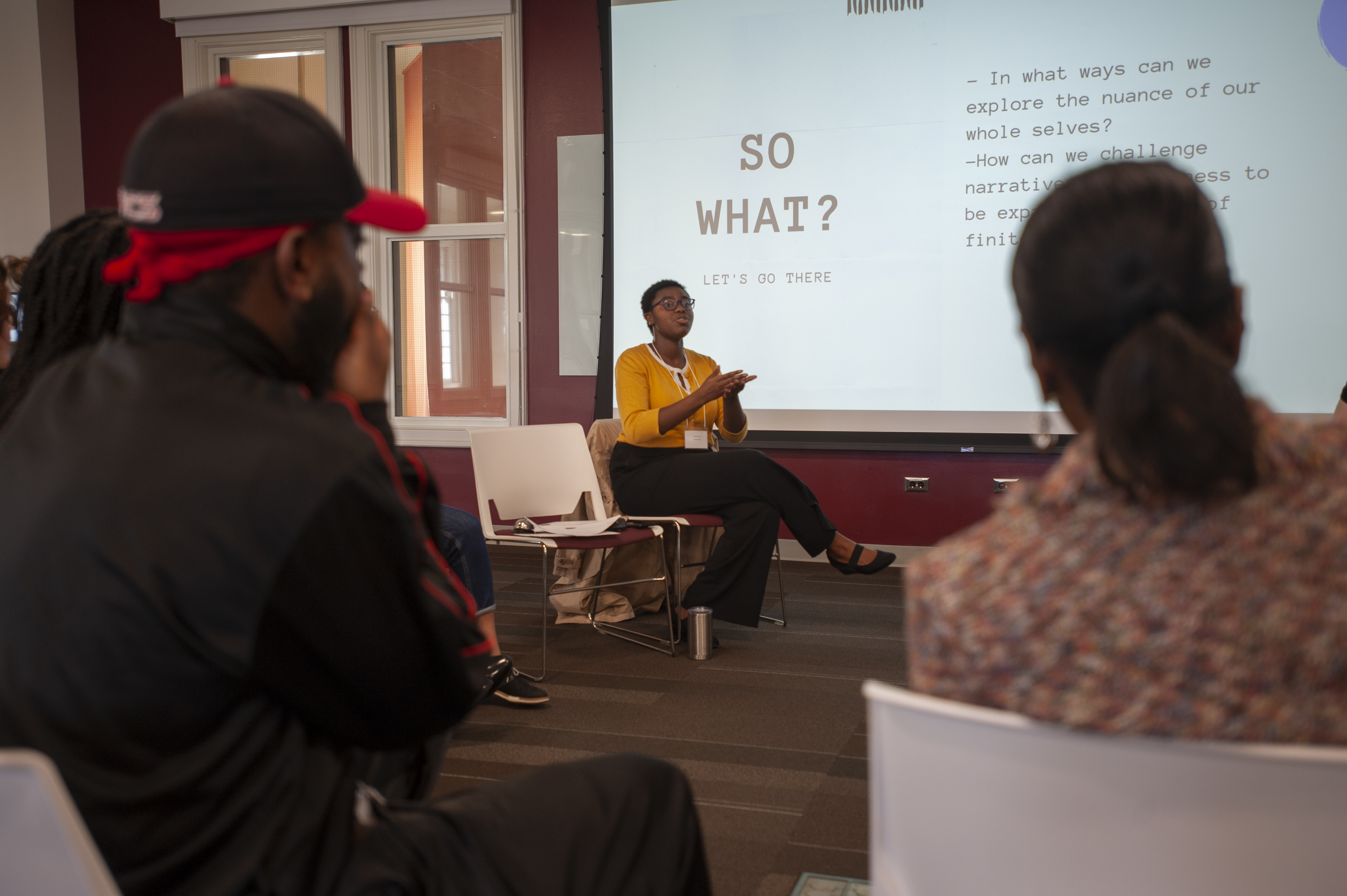
Elon alumni Bridgette Agbozo 鈥�19 presented on 鈥淚ntersectionality: The Kaleidoscope of Life.鈥� Agbozo spoke about what 鈥渋ntersectionality鈥� means and the benefits of an intersectional approach in academia.
The term 鈥渋ntersectionality鈥� was coined by Columbia Law School and UCLA School of Law Professor Kimberl茅 Crenshaw. Intersectionality is 鈥渁n approach that emphasizes the valuable interplay of multiple identities and acknowledges 鈥榗onflicting dimensions of privilege,鈥欌�� Agbozo said in her presentation.
鈥淚 think it’s really important to think about how academia frames intersectionality as it was written into existence in such a format,鈥� Agbozo said. 鈥淒ominant research culture has not always highlighted the voices of historically and presently marginalized groups of people, so there hasn’t always been this massive record of the experiences of people.鈥�
Agbozo spoke about her research in college on emerging gay adult black men who were between the ages of 17 and 24. She highlighted the importance of studying the intersection of all these identities. 鈥淚 think really challenging researchers to use an intersectional approach can be a way to humanize research,鈥� Agbozo said.

In another Feb. 7 session, Professor of Philosophy and Chair of the Department of Philosophy Stephen Bloch-Schulman, Archivist and Assistant Librarian Libby Coyner and Nathan Jones 鈥�20 presented on 鈥淲hite Memories and Black Futures.鈥� The session focused on how the future of racial justice is impacted by which events are remembered and which are forgotten.
Attendees looked at Elon鈥檚 history and how the university chooses to portray its history, including the book, 鈥淓lon College Its History and Traditions鈥� by former Elon professor Durward Stokes.
鈥淣ate, Libby and I wanted us to all think about this question about how white people like to remember, in part because it tells us about what it means to be a white 鈥榢nower鈥�,鈥� Bloch-Schulman said. 鈥淲hat are the things that white people are willing to acknowledge, either publicly or privately, what are the things that they ignore, often willfully, often in some complicated, partially willful, partially unwilful way.
Bloch-Schulman brought up the idea of 鈥渂enign ignorance,鈥� a concept coined by philosopher Alexis Shotwell.
鈥淭he idea is this: nobody told me, I didn’t have any idea, if someone had taught me that this is what was going on, I would know,鈥� he said.
Bloch-Schulman explained the necessity in acknowledging uncomfortable truths about race and racism.
鈥淲e wanted to present this at a conference about black futures because it is our contention and, I would suggest, our work, the three of us, and we hope everybody’s here, to tell the past honestly because until we tell the past honestly it’s not clear what black futures could be,鈥� he said.
In her keynote speech, Baker spoke about her journey into the field of public health and her work with racial health inequities. Baker鈥檚 work uses a community-based participatory research (CBPR) approach, wherein community partners get to contribute expertise and are involved in research, instead of being separate from the researcher.
At the start of her career, Baker was a physical therapist and explained that her low-income patients and her patients of color were not getting better as quickly as her white patients but wasn鈥檛 sure why.
鈥淚 never was given any kind of analysis lens to understand that and when we don’t have a lens to understand why phenomenon we see is happening then we just make up stuff in our heads based on the information that we do have,鈥� Baker said. 鈥淥ften times that leads to blaming communities or blaming people for the circumstances that they find themselves in.鈥�
Dissatisfied in that kind of work, she decided to go into public health because it helps explore root causes of inequities, Baker said.
Baker discussed her work with SpiritHouse, an arts-based organization led by black women in Durham. She worked with the organization on a project called 鈥淗arm-Free Zone.鈥� The initiative was 14-week training to hold the community accountable to itself and reduce reliance on the police.
She was asked to evaluate the program and she conducted interviews and talked with focus groups. In addition, a local artist sat in on the training to draw what she saw reflected in the community conversations. These art pieces were another form of evaluation for the project.
鈥淭hat was a really interesting opportunity for me to see how if you work with people and share power and decision making, you can create something completely new that you wouldn’t have expected to have ever created,鈥� Baker said.
She spoke about racial disparities in the medical system and brought up a report by the Institute of Medicine about unequal treatment in medical care.
鈥淩acial disparities in health care outcomes are present even when people have the same access to the same type of insurance, the same type of level of care, the same type of physical ailments, the same level of chronic problems,鈥� Baker said.
Baker also does work with the Greensboro Health Disparities Collaborative, a group of community leaders, advocates, researchers, university faculty and others. They partner with academics for several studies, specifically with disparities in medical care.
Bell hopes that through the Black Solidarity Conference, attendees gained more knowledge about allyship.
鈥淚 think it’s important for the campus to know that you can be in solidarity with black people, black issues, black experiences and not be black,鈥� he said.
The conference is a time to celebrate the black community as a whole and on Elon鈥檚 campus, he said. 鈥淔or my black students, faculty and staff, I really want this to be a charge for solidarity, a push for solidarity and a time to reflect and to be happy on all the things we’ve done, all the things we’re doing and all the things that we will do as we welcome new black students onto this campus,鈥� Little said.