


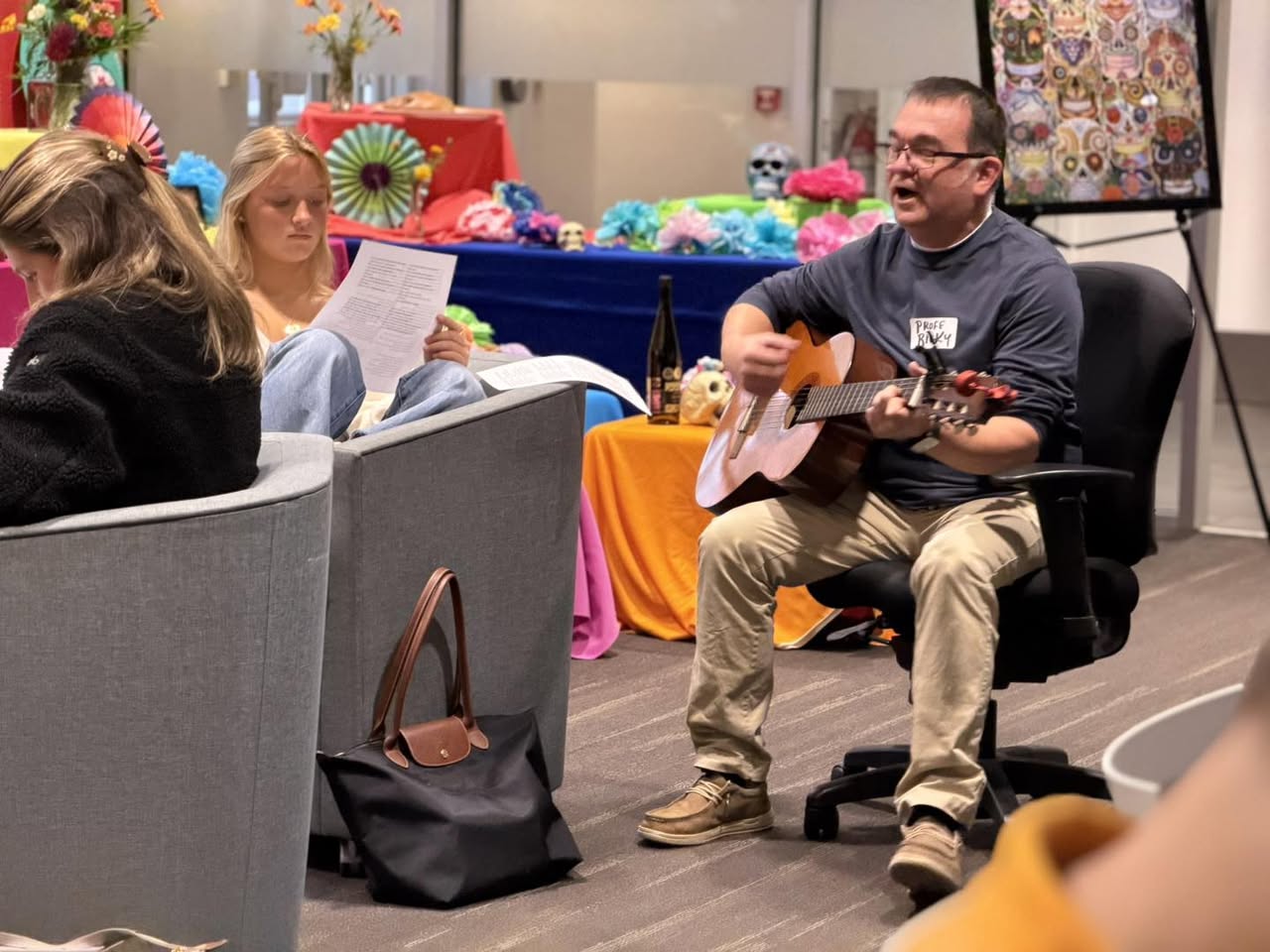
福利亚洲国产精品鈥檚 Department of World Languages and Cultures celebrated D铆a de los Muertos through a weeklong exploration of Mexican cultural heritage, music and remembrance.
More than 300 Elon students and 35 visiting high school students participated in a weeklong celebration of Mexican cultural heritage, music, remembrance and intercultural learning.
From Oct. 28 to Nov. 4, Carlton Commons at 福利亚洲国产精品 became a vibrant gathering place for cultural exploration and remembrance as the Department of World Languages and Cultures hosted its annual D铆a de los Muertos (Day of the Dead) celebration.
Organized by April Post, associate teaching professor of Spanish, and Ricky Mendoza Casta帽o, assistant teaching professor of Spanish, the celebration welcomed approximately 309 Elon students and 35 students from two local high schools, along with faculty, staff and visiting educators.
At the center of the celebration was a traditional ofrenda, or commemorative altar, decorated with photographs, flowers, candles and symbolic offerings honoring loved ones who have passed away. The altar also encouraged reflection on victims of violence, conflict and other tragedies around the world, emphasizing remembrance, compassion and shared humanity.
Learning through culture, music and remembrance
D铆a de los Muertos, traditionally observed on Nov. 1 and 2, celebrates the enduring connections between the living and the deceased. In 2008, UNESCO inscribed the Indigenous Festivity Dedicated to the Dead on its Representative List of the Intangible Cultural Heritage of Humanity, recognizing its cultural significance.
Throughout the week, students from introductory, intermediate and advanced Spanish courses visited the altar to explore its history, symbolism and cultural importance.
Participating faculty included Pablo Celis-Castillo, Daniel Castelblanco, Mina Garc铆a, Ketevan Kupatadze, Mayte de Lama, Federico Pous, April Post and Ricky Mendoza Casta帽o. French students accompanied by Guyl猫ne Deasy also participated, extending the experience beyond Spanish-language instruction.
The colorful decorations included traditional papel picado, intricately cut paper decorations created by students from Elon’s Club de Espa帽ol (Spanish Club) under the guidance of Bethanny Sudibyo, assistant teaching professor of Spanish. Their contributions added an important element of Mexican artistic tradition to the celebration.
Music also played a meaningful role. During one of the visits, Mendoza Casta帽o played the guitar and led students in singing La Llorona (鈥淭he Weeping Woman鈥�), a traditional Mexican song featured in the animated film Coco. Students also shared personal tributes to individuals they wished to remember, connecting cultural learning with personal reflection and storytelling.
Building bridges between Elon and local schools
One of the highlights of this year’s celebration was a visit from The Burlington School, whose Spanish Honors IV and AP Spanish Language and Culture students joined Elon students for an immersive cultural and linguistic experience.
Accompanied by Paola Contreras, a Colombian educator and upper-school Spanish teacher, 11 sophomores, juniors and seniors participated in activities with Mendoza Casta帽o’s SPAN 1020 students. Together, they explored the altar, discussed cultural traditions, sang songs, shared personal reflections and enjoyed pan de muerto, a traditional Mexican sweet bread.
Contreras also facilitated an interactive Spanish-language lesson, giving visiting students an opportunity to experience university-level classroom discussions.
In a social media post, The Burlington School highlighted its students’ confidence communicating in Spanish and the meaningful connections established with Elon students and faculty. The group continued its language-learning experience at Iraz煤 Coffee, where students practiced Spanish while interacting with owner Rod Salazar.
The visit was documented by Alex Stevens, director of communications at The Burlington School, whose photographs captured moments of musical expression, cultural exchange and collaborative learning.
The department also welcomed Tara Dolly, who brought approximately 30 high school students to campus for an Elon Spanish experience.
Beyond exploring D铆a de los Muertos traditions, visiting students interacted with Elon students in Spanish, learned about the university’s academic programs and toured campus. The experience left a lasting impression: one visiting student later shared with her father that the visit had strengthened her desire to attend college.
A celebration made possible through collaboration
The celebration featured 22 loaves of pan de muerto prepared by El Dorado Bakery in Burlington, a local business that has supported this annual tradition for approximately two decades. Sharing the traditional bread offered participants another opportunity to appreciate the relationship between food, cultural identity and collective memory.
The organizers extend their sincere appreciation to Elena Schoonmaker-Gates, chair of the Department of World Languages and Cultures, for providing financial support for the celebration.
Annetta Womble, program assistant for World Languages and Cultures, related interdisciplinary programs, and International and Global Studies, coordinated space reservations, tables and logistical arrangements.
The World Languages and Cultures student assistants played an essential role in preparing the altar and supporting the celebration, working closely with Assistant Teaching Professor of Spanish Ricky Mendoza Casta帽o to create a welcoming and meaningful cultural experience.
Honoring the past, celebrating life
The annual D铆a de los Muertos celebration reflects 福利亚洲国产精品’s commitment to experiential education, intercultural understanding and community engagement.
More than a cultural exhibition, the event offered opportunities to explore the importance of family, memory and identity while strengthening connections between the university and the surrounding community.
Through music, storytelling, artistic expression, personal remembrance and shared traditions, the celebration demonstrated how language education can foster both academic learning and meaningful human relationships.
The Department of World Languages and Cultures looks forward to welcoming even more students, families, educators and community members in future years to honor cherished memories, celebrate cultural heritage and continue this meaningful tradition together.