


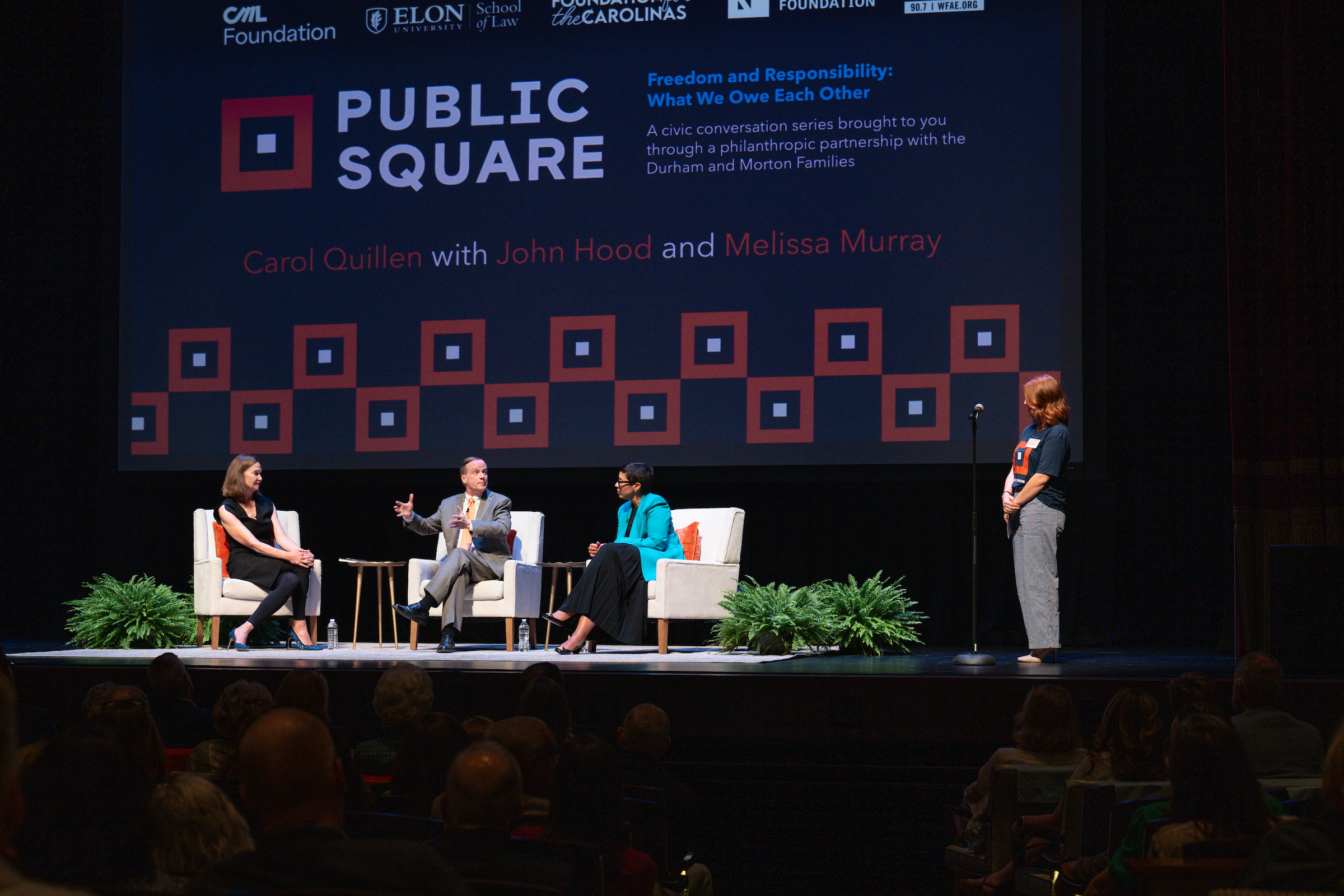
John Hood and Melissa Murray joined moderator Carol Quillen for Charlotte's inaugural Public Square conversation. Elon Law students from Greensboro and Charlotte helped facilitate the event.
Differing perspectives on government power, individual liberty and civic responsibility took center stage at Charlotte’s inaugural conversation, where Elon Law students helped facilitate a discussion about the principles that sustain American democracy.
鈥淔reedom and Responsibility: What We Owe Each Other,鈥� held Oct. 29 at the Carolina Theatre at Belk Place, brought together John Hood, president of the John William Pope Foundation, and Melissa Murray, the Frederick I. and Grace Stokes Professor of Law at New York University School of Law.
Carol Quillen, former president of Davidson College and former CEO of the National Trust for Historic Preservation, moderated the conversation.
鈥淭his is not a debate. It’s a conversation,鈥� Quillen told the audience at the outset. 鈥淥ur hope is that as John Hood and Melissa Murray share their ideas, their knowledge, and their points of view, each of us will find insights that can enrich our own understanding and also provide tools that we can use to be more effective at engaging others with whom we might disagree.鈥�
Public Square is a civic conversation series produced by to encourage thoughtful engagement across ideological differences and strengthen civic life. The library foundation is producing the series with programming partners including the , 听补苍诲 Elon Law. The Durham and Morton families are supporting partners.
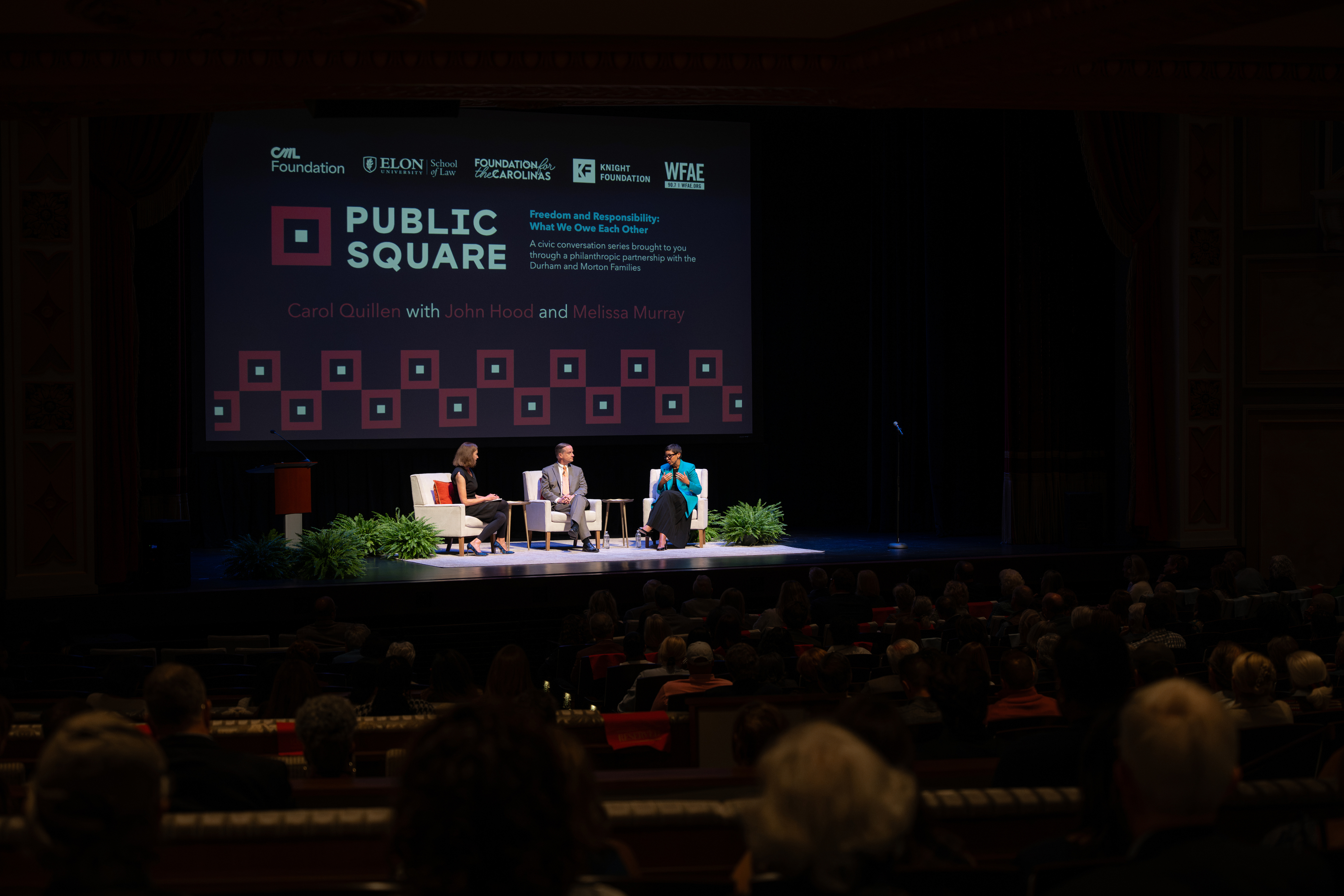
Hood emphasized individual liberty, limited government and the responsibility of citizens and civic organizations to address community needs. Murray explored the Constitution’s evolving protections and how historical injustices and structural barriers influence opportunities for meaningful participation in American society.
Hood described the Constitution as a framework designed to accommodate disagreement among people with different beliefs, political views and priorities.
鈥淲e can disagree about religion. We can disagree about faith of any kind. We can disagree about political issues. We can disagree about how we want to live, what we want to eat, what team we’re going to root for, whatever it is,鈥� Hood said.
The nation’s founders anticipated those disagreements, he explained, and established a constitutional system intended to prevent them from escalating into threats to individual liberty or violence.
The challenge, Hood said, is to view people who hold opposing beliefs 鈥渘ot as bigots, not as villains and not as liars鈥� 鈥� but as individuals with inherent worth and people whose perspectives may have merit, Hood said.
Murray approached the Constitution from a different perspective, emphasizing how the nation’s founding principles evolved through struggles over citizenship, equality and individual rights.
She pointed to the Civil War and Reconstruction-era amendments as transformative moments in American constitutional history, arguing that understanding the nation’s founding requires acknowledging both its ideals and its failures.
鈥淚f we aren’t attentive to it, and we don’t try to reckon with it, and see what the residue of it means for us today, we could still make the same mistakes over and over and over again,鈥� Murray said.
She also emphasized the importance of constitutional literacy and the responsibility to consider perspectives that challenge one’s own beliefs. Drawing on her experience in law and teaching law students, she described the value of examining opposing arguments rather than dismissing them.
In law, 鈥渨e also literally have to do justice to another side, to make the argument as sharp as possible, because that’s the only way to make your argument better,鈥� she said.
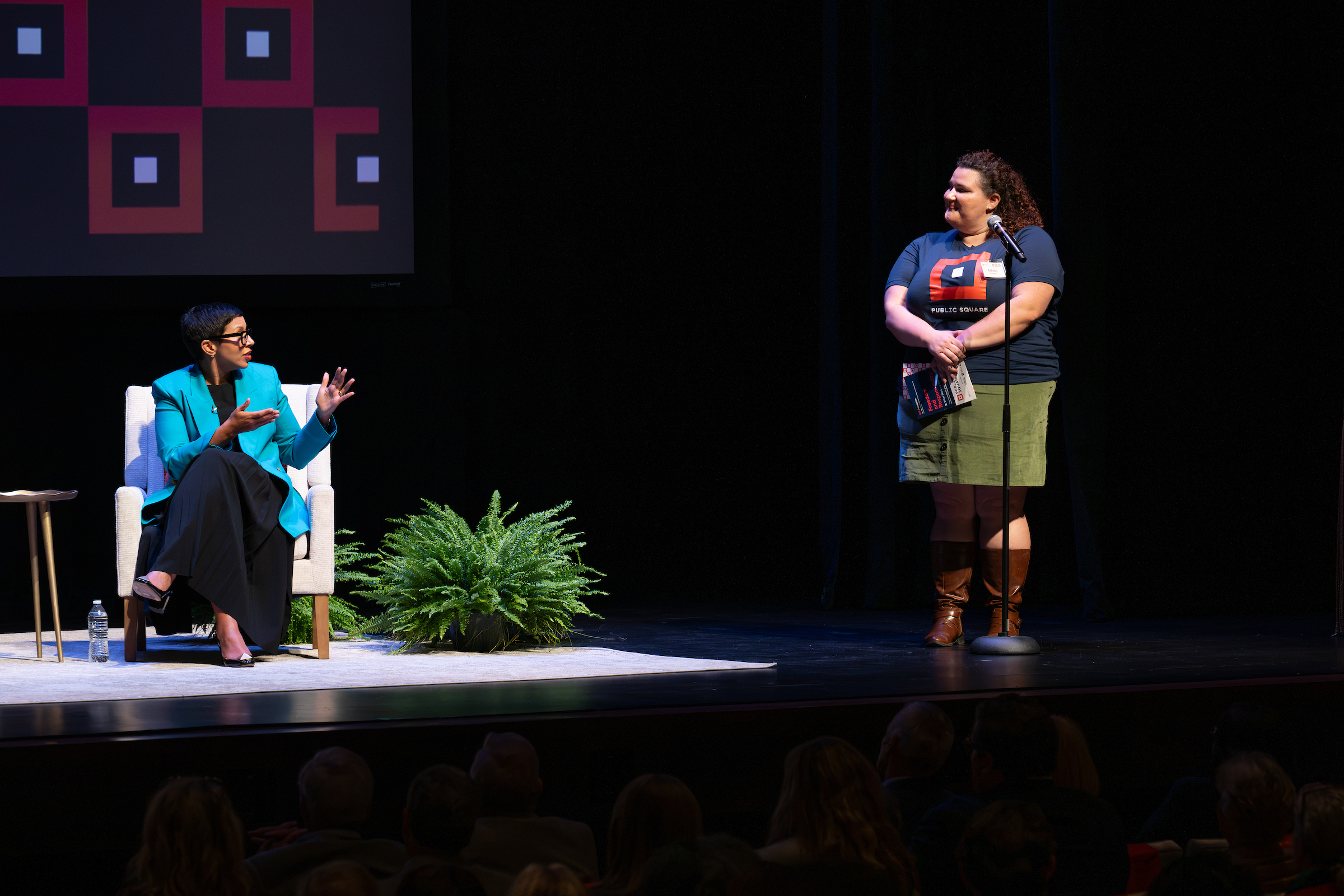
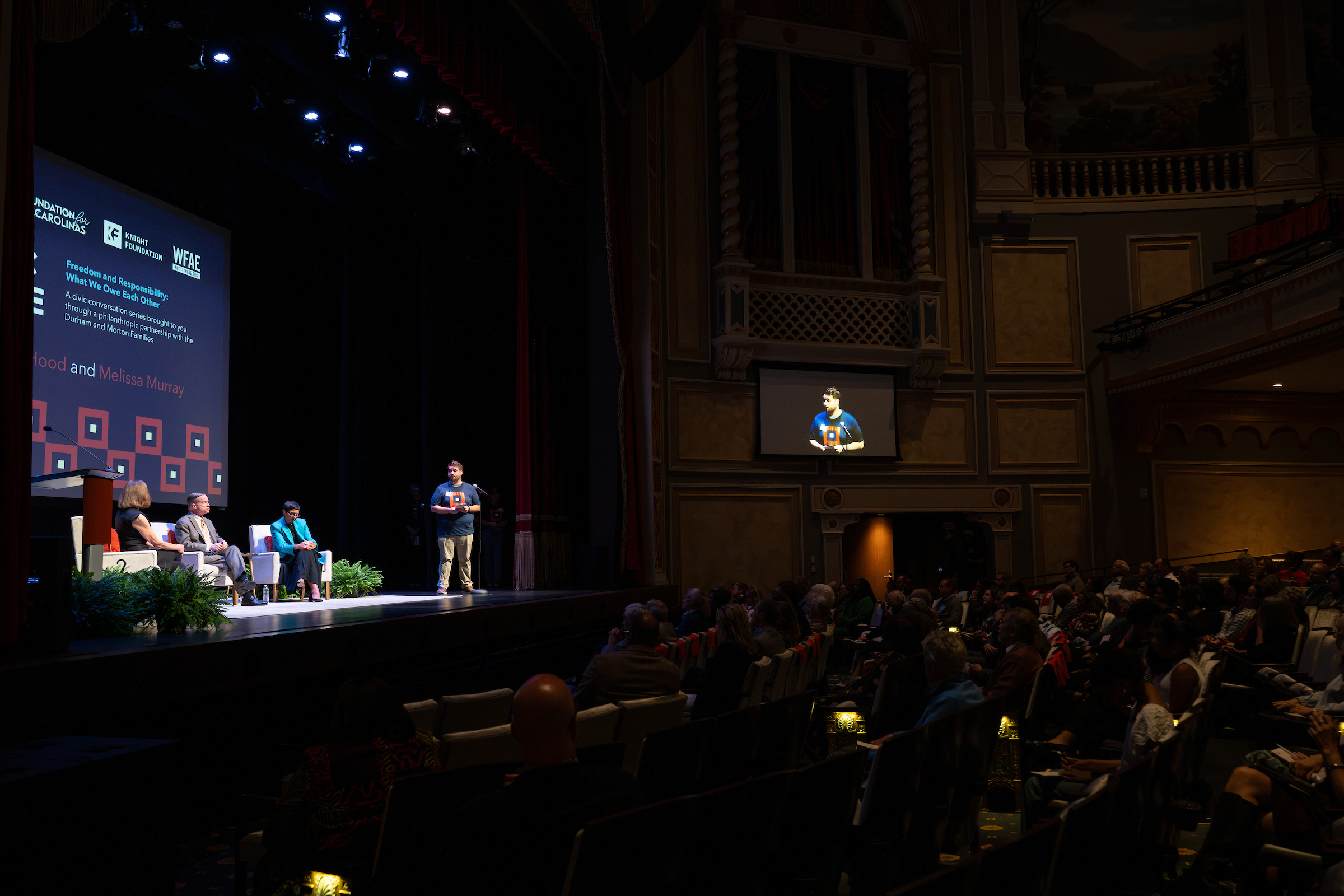
Four Elon Law students served as content navigators, helping explain constitutional principles, collect audience questions and facilitate discussion.
Stellarose Emery L鈥�27 and Ashley Holmes L鈥�26 represented Elon Law’s Greensboro program, while Mandy Mead LF鈥�29 and Jeremy Yagoda LF鈥�29 represented the Charlotte Flex Program.
Audience questions addressed respectful disagreement, civic education, constitutional interpretation and the responsibilities of citizens in maintaining democratic institutions.
Two additional Public Square conversations are scheduled for spring and fall 2027, exploring 鈥淭he Art of Compromise鈥� and 鈥淭ruth and Trust,鈥� respectively.