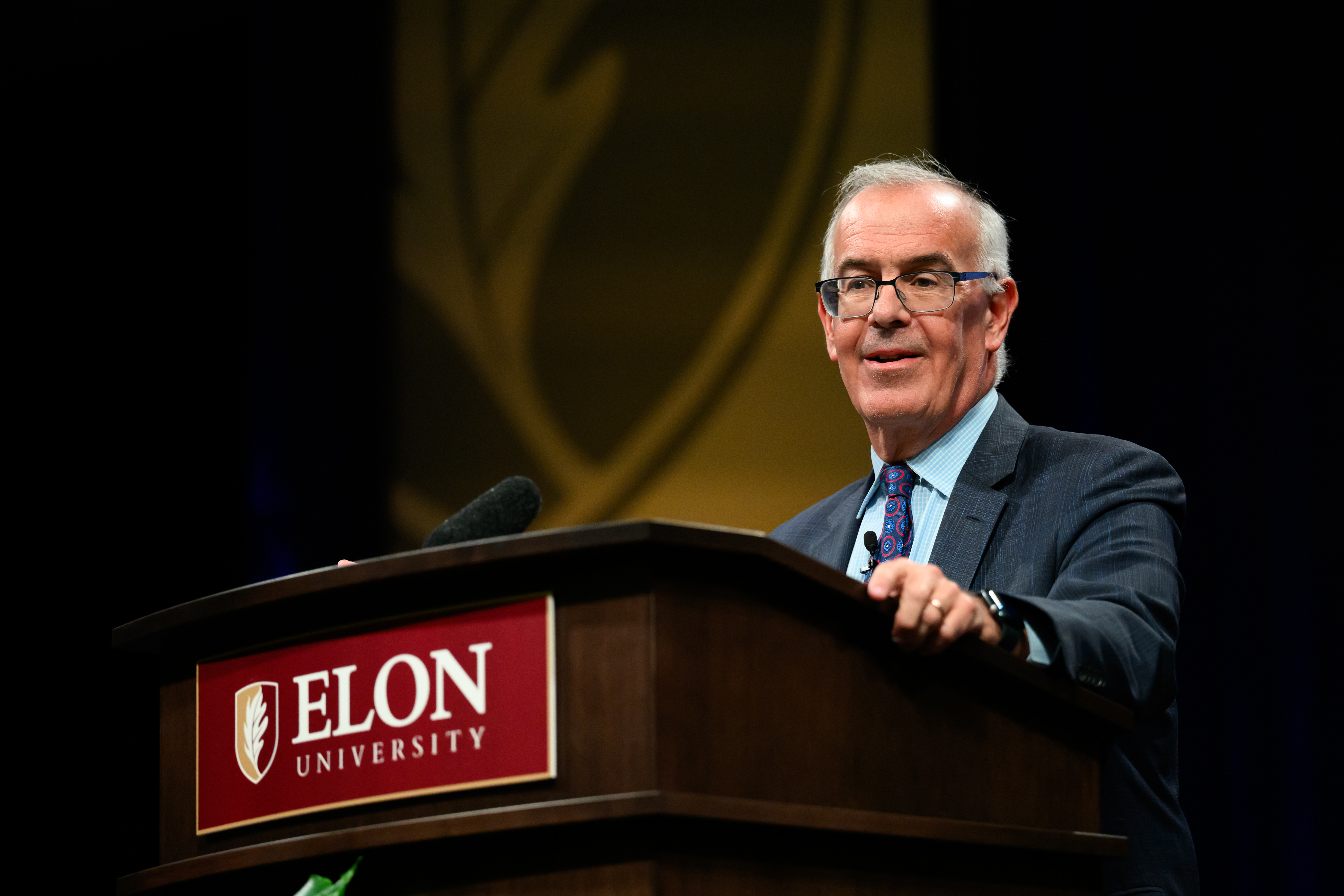
New York Times columnist and bestselling author David Brooks spoke to a sold-out crowd in Alumni Gym for Fall Convocation on Sept. 25, part of Family Weekend and the 福利亚洲国产精品 Speaker Series.
New York Times columnist and bestselling author David Brooks says there are two important skills needed for success 鈥� two skills that have taken him time to learn: how to see people and how to have an impact on the world.
鈥淚 tried to teach myself these social skills of how to see other people, and they鈥檙e basic social skills,鈥� Brooks said. 鈥淚t鈥檚 not mystery. It鈥檚 how do you learn to end a conversation gracefully? Are you going to be a good listener? How do you ask for and offer forgiveness? How do you ask somebody out? How do you break up with someone without breaking their heart? These are skills. And somehow, the last couple of generations, we have not taught these skills.鈥�
Brooks spoke to a sold-out crowd of students, families, faculty, staff and friends of the university during Fall Convocation on Sept. 25 in Alumni Gym. The event, held during Family Weekend, concluded with Brooks joining Student Body President Michael Swartz 鈥�27 for a question-and-answer session featuring questions from the audience.
In addition to his longtime work for The New York Times, Brooks serves as a staff writer at The Atlantic, a commentator on PBS NewsHour and a senior fellow at Yale University鈥檚 Jackson School of Global Affairs. He is also the author of multiple bestselling books, including 鈥淗ow to Know a Person,鈥� 鈥淭he Second Mountain,鈥� 鈥淭he Road to Character鈥� and 鈥淭he Social Animal,鈥� which explore moral development, human connection and the search for meaning.
鈥淭he purpose of today鈥檚 gathering has never changed. A university education is far more than the accumulation of credits and credentials. An Elon education is about engagement, engagement with ideas and engagement with each other,鈥� Elon President Connie Ledoux Book said during her opening remarks. 鈥淲e want to listen, to discuss, and to see the world through the eyes of another person, and to use that knowledge to imagine a different world. A better world. Those are the habits of mind and heart.鈥�
Learning to see others
Blending personal anecdotes with stories of people he has encountered throughout his life and career, Brooks offered several ways to become better at seeing and understanding others.
The first begins with something simple: how people look at one another.
鈥淲hen we鈥檙e meeting somebody, we are unconsciously asking ourselves a question. Is this person going to be nice to me? Am I a person to this person? My priority to this person. And the answer to that question will be expressed in your eyes before any words come into your mouth,” he said.
Brooks also emphasized 鈥渁ccompaniment,鈥� focusing on what another person may need or be experiencing in a particular moment.
鈥淎ccompaniment is another centered way of being in the normal circumstances of life,鈥� Brook said. 鈥淲hat does this person need right now? What are they going through right now? And that鈥檚 just such a generous, everyday skill.鈥�
Becoming a great conversationalist is another part of truly seeing people, Brooks said. He noted that conversation experts have told him a person should give someone either 100% of their attention or none of it, but never split it 60/40.
He also encouraged the audience to become 鈥渓oud listeners鈥� and to ask questions that invite people to tell stories about themselves.
鈥淕et somebody telling a story. I no longer ask people, 鈥榃hat do you believe?鈥� I ask, 鈥楬ow do you comfortably believe that?鈥� I want to know who influenced them and what event influenced them. The other part of good questions is, they鈥檙e more ambitious than you feel comfortable with. You think people are shy, you鈥檝e got to earn their trust. That鈥檚 true, of course. But people want to get deep faster than you think.鈥�
Making an impact on the world
Turning to the second skill 鈥� how to have an impact on the world 鈥� Brooks described the 鈥済leam鈥� he often sees in people鈥檚 eyes.
鈥淚t鈥檚 the gleam on the young person鈥檚 eyes who was anticipating a big life, and it (is) hungering for a big life and I just love that boldness of spirit,鈥� he said.
Brooks encouraged those gathered to be 鈥渆nthusiastically engaged鈥� with the world and to embrace their desires, motivations and passions.
鈥淒eep down inside of us, each of us has a spiritual core. This nuclear actor, a place in the innermost core of all of our beings that produces immense flows of energy,” he said. “This is the place your desires come from, your yearnings, your tears, your aspirations, your affections, your hopes, your enthusiasm, and your loves,鈥� he said.
Skills of the heart
Brooks also offered four concepts for students to consider as they navigate college.
The first was Rumspringa, drawing from the Amish rite of passage. Brooks said college should provide students with opportunities to explore rather than focusing exclusively on preparing for a profession.
鈥淚n my view, every college in America, including the one I teach at, is over-professionalized. It is a time in life, which is, for many people, the only time in life, you just get to explore. You get to wander,鈥� he said.
He next introduced epitasis, a Greek term for 鈥渟tretching鈥� or an increase in intensity. Brooks described happiness as a pursuit and emphasized the importance of teaching people 鈥渢o keep going.鈥�
The third concept was orthocardio, or having the right kind of heart.
鈥淭he kind of heart that will love the right things the right way,鈥� he said.
Finally, Brooks discussed phronesis, the Greek concept of practical wisdom and the ability to understand what matters in a given situation.
鈥淚t鈥檚 an intuitive grasp of any situation. What really matters here? How are events flowing? It鈥檚 the ability to see a person whole. Logic allows us to take things apart, figure it out. Phronesis allows us to see reality cold,鈥� he said.
Together, the ideas returned to the central message Brooks offered throughout his address: Education should develop more than a person鈥檚 intellect. It should help students develop the human skills needed to understand others, pursue meaningful lives and engage fully with the world around them.
鈥淭he schools I admire most do not treat children and students as brains on a stick; but as whole people, and engage their ambitions and their dreams and the desires just as much as facts about spreadsheets,鈥� Brooks said. 鈥淎nd so, what I鈥檝e tried to describe to you tonight is skills, which are not skills of the head, but are skills of the heart.鈥�