


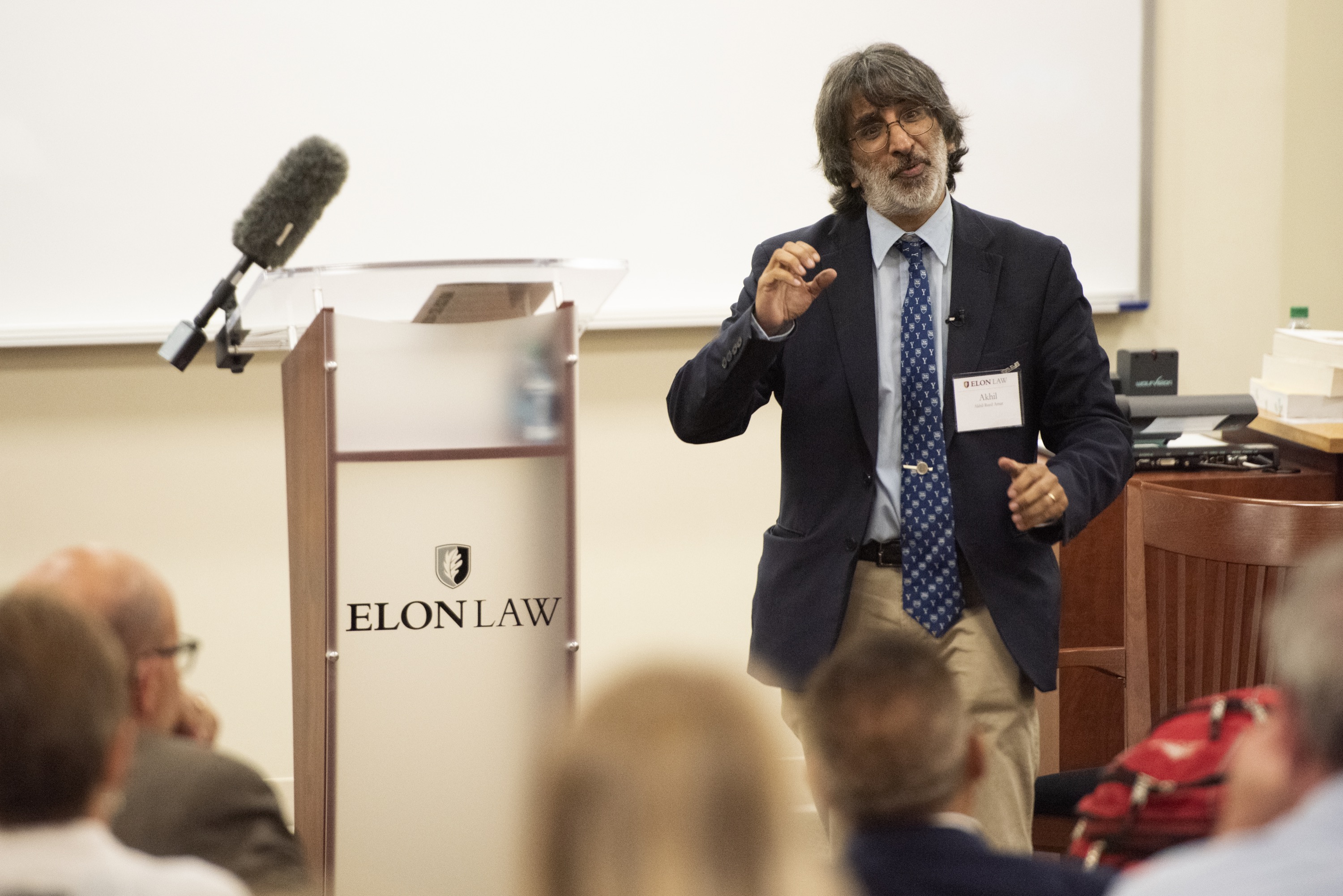
The Elon Law Review鈥檚 2019 Symposium on Judicial Independence brought to Greensboro some of the nation鈥檚 leading experts on the American court system, with keynote remarks by a Yale Law scholar who favors keeping the U.S. Supreme Court at nine justices while reconfiguring the way they are appointed and help decide cases.
This year marks the sesquicentennial of the Judiciary Act of 1869, legislation that set the number of justices on the Supreme Court of the United States at nine – a figure that some of the best legal minds in the United States believe shouldn鈥檛 be touched.
After all, they argue, there are better ways to make the court more efficient. More fair. More likely to be respected by the public for controversial decisions. Whether such changes happen is anyone鈥檚 guess.
The future of the courts served as the backdrop to the recent 2019 Symposium on Judicial Independence, an event that brought several dozen lawyers and judges from across North Carolina to downtown Greensboro where they learned from a list of presenters who included law professors, practicing attorneys, and a judge for the U.S. Court of Appeals for the Fourth Circuit.
Each expert at the Sept. 27 symposium offered varied views on what ails federal and state courts and how to best resolve emerging issues tied to public legitimacy, judicial selection, and the politicization of the legal system. The U.S. Supreme Court generated the most attention throughout the day as various proposals affecting the structure of the nation鈥檚 highest court have been introduced by Democratic candidates seeking the White House in 2020.
Yet one of the top constitutional law scholars in the United States – and the keynote speaker for the Elon Law Review鈥檚 2019 Symposium – points to the snowball effect that any tinkering with the Supreme Court might precipitate in American politics.

鈥淭he problem with partisan changes to the court size is just a game theory point,鈥� Amar said. 鈥淭it will generate tat will generate double tit, which will generate double tat, and it spirals out of control. My guys are in power, so they add some. Then the other party is in power and so they have to add some. If we鈥檙e lucky, they just add the same amount. If we鈥檙e unlucky, they add some more in for good measure. And it鈥檚 endless.
鈥淭hat鈥檚 why we should avoid partisan packing. It will spiral out of control in the long run and we鈥檒l all be worse off.鈥�
How might the Supreme Court be restructured to promote good government instead of partisan ideology? Amar outlined a proposal for which he has advocated in recent years: giving Supreme Court justices life tenure but only allow them to sit en banc for the first 18 years, with seniority based on how long a justice has been on the court.
After 18 years, a justice rotates off the front bench and yet still serves a role in building relationships between the Supreme Court and the lower federal courts, advocating for judicial salaries, or occasionally hearing cases when another sitting justice must recuse him or herself.
Such a structural change to the Supreme Court requires congressional legislation, not a constitutional amendment, Amar said.聽And it gives presidents each term two Supreme Court appointments, making the future of the court a more visceral campaign topic as candidates 鈥� and voters 鈥� know who will rotate off, and how their departures from the front bench will affect court decisions on various issues.
鈥淚t eliminates politically timed retirements,鈥� Amar said. 鈥淭oday, justices sometimes time their retirements to coincide with presidential terms, and that鈥檚 less independent from politics than 鈥業 served my 18 years and I can鈥檛 try to manipulate my exit strategy.鈥� It allows for a more regular and democratic conversation about the judiciary.鈥�
Amar鈥檚 remarks marked the Elon Law Review鈥檚 inaugural Jennings Family Lecture in Memorium to Associate Professor Mike Rich.聽The Jennings family now joins聽the Aycock family, which established the William P. Aycock II Law Review Fund, in supporting the Elon Law Review and its annual symposium programming.
Rich, nationally recognized for his scholarship in criminal law, died of cancer in late 2016 while serving as the Jennings Professor and Emerging Scholar, an Elon Law professorship endowed by the Jennings Family – Maurice Jennings Sr. ’57 and his wife, Linda, and Maurice “Burney” Jennings Jr. ’87 and his wife Dina ’87.

The new lecture as part of the Elon Law Review鈥檚 annual symposium will ensure that 鈥淢ike鈥檚 contributions to our law school and to American law will be remembered for posterity,鈥� said Elon Law Dean Luke Bierman.
Amar was joined at the symposium by several distinguished legal scholars, judges, former judges, and attorneys whose shared interest in the judiciary brought them to North Carolina. Speakers and panelists also included:
- (Brennan Center鈥檚 Democracy Program)
- (Akerman LLP)
- (University of New Mexico School of Law, in absentia)
- (Duquesne University School of Law)
- (B.K. Leonard Law Firm)
- (University of South Alabama)
- (University of North Carolina)
- (University of Tennessee College of Law)
- (U.S. Court of Appeals for the Fourth Circuit)
Ledewitz, Nelson, Kalmanson, Leonard and Kastenberg have had papers accepted for publication in the next issue of the Elon Law Review and they each outlined their arguments about the future of the courts – both federal and state – as part of their presentations. Kastenberg鈥檚 abstract was read by a symposium co-editor when a family concern earlier in the week led to cancellation of his visit.

鈥淣ine justices for 150 years. It seems almost sacrosanct,鈥� Bierman said in welcoming attendants to the symposium. 鈥淵et our moment in history is fraught. Institutions, processes, expectations – things we have thought of as permanent no longer carry that weight in our moment in history. Will judicial independence, or for that matter the rule of law, be tossed on the garbage heaps of other institutions that we now seem to find expendable?
鈥淚t is in this spirit that the Elon Law Review undertakes to celebrate the sesquicentennial of the Judiciary Act of 1869 as a way to measure, to think, and to ponder the current status of judicial independence. Our participants today come from many different perspectives, offering us an opportunity to think creatively and differently 鈥� which we at Elon Law take as the highest praise.鈥�
Planning for the symposium was led by Zachary Green L鈥�19 and Kathryn Magoon L鈥�19, the Elon Law Review鈥檚 current symposium co-editors. Both called the event a success and praised the quality of the conversations sparked by the presenters.

鈥淥ur attendees were inquisitive and eager to ask questions, challenge the speaker鈥檚 ideas, and participate in important discussions,鈥� Magoon said. 鈥淚 hope they and our speakers left the symposium on Friday with the hope that we as a legal profession, and as citizens, can come together to make our judicial system work better for the people.鈥�
Green said he believed likewise.
鈥淚t鈥檚 an honor to be a part of an event that brought together the practitioners of our community and some of the nation鈥檚 leading scholars,鈥� he said. 鈥淚鈥檓 proud of the program that Elon Law Review and Elon Law put together this year and look forward to the many more that will follow in the years to come.鈥�
福利亚洲国产精品 Elon Law:
福利亚洲国产精品 School of Law in Greensboro, North Carolina, is the preeminent school for engaged and experiential learning in law. With a focus on learning by doing, it integrates traditional classroom instruction with course-connected, full-time residencies-in-practice in a logically sequenced program of transformational professional preparation. Elon Law鈥檚 groundbreaking approach is accomplished in 2.5 years, which provides distinctive value by lowering tuition and permitting graduates early entry into their legal careers.
福利亚洲国产精品 the Elon Law Review
The Elon Law Review was established in 2008 as the student-run and student-edited scholarly journal of the 福利亚洲国产精品 School of Law. With each issue, the Elon Law Review strives to advance legal education and scholarship through the contribution of intelligent discussion and analysis of the law. In addition to publishing an annual issue that examines novel and significant topics of legal scholarship, the Elon Law Review hosts a yearly symposium on an emerging topic in the legal community.